Zero Cost EMI and BNPL India 2026 — The Real Hidden Costs Exposed
Key Takeaways
- "Zero cost EMI" is a marketing term. The interest (typically 12–18%) is paid by the merchant as a discount to the bank — meaning you forgo the cash discount you would have received if you paid upfront.
- On a ₹30,000 appliance, zero cost EMI typically costs you ₹1,500–₹3,000 more than paying with a debit card or UPI (because you give up the equivalent cash discount).
- Processing fees on zero cost EMI (₹99–₹499 per transaction) are real, upfront costs — not zero.
- BNPL products from Simpl, LazyPay, ZestMoney (now restructured), and others carry late payment fees of 2–4% per month — higher than credit card revolving rates.
- Zero cost EMI is genuinely beneficial for large purchases (₹50,000+) on a card with good rewards, where you preserve cash flow at minimal real cost.
Walk into any Croma, Vijay Sales, or open Flipkart, Amazon, or Myntra during a sale — and you will see "No Cost EMI" on almost everything above ₹5,000. It is one of the most pervasive and least understood financial products in Indian retail. The word "zero" implies no cost. But finance doesn't do free. There is always a cost — the question is who pays it, when, and how it is hidden.
This guide exposes the full cost structure of zero cost EMI and BNPL products in India and gives you a framework to decide when using them is actually smart and when you are paying a premium for the illusion of affordability.
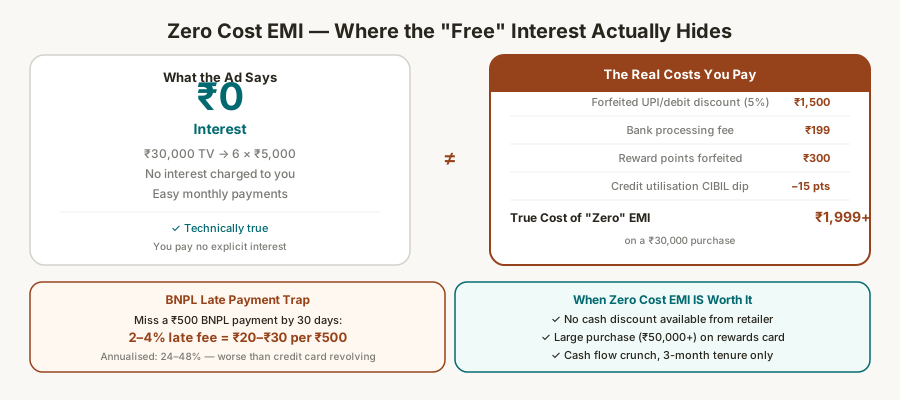
How "Zero Cost EMI" Actually Works
Here is the mechanism that most buyers never see:
- You buy a ₹30,000 TV on 6-month zero cost EMI via your credit card.
- You pay ₹5,000/month for 6 months. Total paid: ₹30,000. No interest charged to you.
- But: The bank would normally charge 15% p.a. on this credit (≈ ₹1,125 for 6 months).
- Who pays this ₹1,125? The merchant/brand — it is deducted from what they receive.
- The merchant compensates by charging a higher price for EMI purchases, or by withdrawing the cash discount they would have offered for UPI/debit payment.
The cost is in the opportunity cost of the cash discount you gave up.
Most brands offer 3–7% cash discounts for upfront payment via UPI or debit card — especially offline. On a ₹30,000 purchase:
- Cash discount (5%) = ₹1,500 saved if you pay upfront
- Zero cost EMI = ₹30,000 paid over 6 months, no cash discount
Net cost of "zero cost EMI" = ₹1,500 (the discount you gave up) + processing fee (if any).
This is not nothing — but it may be worth it if you genuinely need to spread the payment and earn credit card rewards in the process.
The Cost Components: Every Hidden Charge
1. Processing fee (most common)
Banks charge a one-time processing fee on EMI conversions:
- HDFC Bank: ₹199 per EMI transaction
- ICICI Bank: ₹199–₹299
- SBI Card: ₹99–₹249
- Axis Bank: ₹199
- Kotak: ₹199
On a ₹10,000 purchase, a ₹199 processing fee is a 1.99% upfront cost — comparable to the interest you would have paid on a short-term credit facility.
2. GST on interest (if applicable)
If the EMI is not truly zero-cost (e.g., a "low-cost EMI" product), 18% GST applies to the interest component. On ₹500 in interest, add ₹90 GST.
3. Forfeited cash discount
As explained above, the largest hidden cost. This varies by retailer and product category:
| Category | Typical Upfront Discount | EMI Discount | Hidden Cost of EMI |
|---|---|---|---|
| Consumer electronics | 3–7% | 0–2% | 1–7% of price |
| Smartphones | 2–5% | 0–1% | 2–5% of price |
| Appliances (ACs, fridges) | 5–10% | 0–3% | 2–10% of price |
| Furniture | 8–15% | 0–5% | 3–15% of price |
| Apparel / Lifestyle | 10–30% (sale discounts) | Often not available | Entire sale discount |
4. Credit utilisation impact on CIBIL
Converting a purchase to EMI blocks that portion of your credit limit for the EMI tenure. A ₹30,000 EMI on a ₹1 lakh limit increases your credit utilisation from (say) 20% to 50%. This can temporarily drop your CIBIL score by 10–25 points, which matters if you are applying for a home loan in the next 6–12 months.
5. Rewards points forfeited
Most banks exclude EMI transactions from reward points accrual. A ₹30,000 transaction that would have earned 300 reward points (≈ ₹300–₹600 in value) earns 0 if converted to EMI. Check your card's reward T&Cs before converting.
BNPL vs Zero Cost EMI: What's the Difference?
| Feature | Zero Cost EMI (Credit Card) | BNPL (Simpl / LazyPay / Amazon Pay Later) |
|---|---|---|
| Provider | Bank + card network | Fintech / NBFC |
| Credit check | Full CIBIL check (at card issuance) | Soft check / internal score |
| Interest on timely payment | Zero (if paid as per schedule) | Zero (if paid as per schedule) |
| Late payment fee | 2–3% p.m. revolving rate | 2–4% p.m. flat (often not clearly disclosed) |
| Minimum purchase | ₹1,000–₹5,000 | ₹100–₹500 |
| Credit limit | Card limit | ₹5,000–₹1 lakh |
| Effect on CIBIL | Yes (credit utilisation) | Increasingly reported to bureaus |
| Transparency | Moderate | Low |
BNPL products are designed for smaller, impulse purchases. The zero-late-payment promise is genuine — but the late payment charges are disproportionately high (2–4% per month = 24–48% annualised). Miss a ₹500 BNPL repayment by 30 days: the fee can be ₹20–₹30, which sounds trivial until you have 5 open BNPL accounts across platforms.
The BNPL Debt Spiral Risk
BNPL is structurally designed to lower the psychological friction of spending. Splitting a ₹3,000 purchase into ₹1,000 × 3 months makes it feel cheaper. Neuroscientific research consistently shows that deferred payment reduces purchase inhibition.
The risk: multiple BNPL accounts across Simpl (groceries), LazyPay (food delivery), Amazon Pay Later (shopping), and Flipkart Pay Later (electronics) can each carry balances simultaneously. A user with 4 active BNPL accounts, each with ₹3,000 outstanding, has ₹12,000 in revolving short-term debt — spread across platforms, each with different due dates.
Unlike a credit card statement that shows you one consolidated balance, BNPL debt is fragmented and harder to track. This opacity is a feature for the BNPL provider, not the consumer.
When Zero Cost EMI Is Actually Worth It
Despite the hidden costs, zero cost EMI is a genuinely useful tool in specific scenarios:
Scenario 1: Large appliance with rewards maximisation
You're buying a ₹60,000 washing machine. The retailer offers no extra discount for UPI. You have an HDFC Millennia card that earns 5% cashback on electronics (capped). Converting to 6-month zero cost EMI means:
- You preserve ₹60,000 cash in your account for 6 months (earning ~₹1,500 in FD interest)
- You pay ₹199 processing fee
- Net cost: ₹199 − ₹1,500 = effectively free or slightly positive
Scenario 2: Short tenure (3 months) on a high-reward card
Zero cost EMI on 3-month tenure with processing fee ₹199 on a ₹15,000 purchase = 1.33% annualised cost. If your card earns 2% cashback, you're net positive.
Scenario 3: Cash flow management during a known tight period
You have three large expenses due in January, and your annual bonus arrives in March. A 3-month zero cost EMI on a ₹40,000 item bridges the gap at minimal cost (₹199 fee) rather than taking a personal loan at 15%.
Scenario 4: No cash discount available anyway
Some categories — new smartphones, laptops from Apple/Samsung at MRP — have fixed prices with no upfront UPI discount. Here, zero cost EMI genuinely costs you nothing except the processing fee.
The Decision Framework: Should You Use Zero Cost EMI?
| Situation | Use Zero Cost EMI? |
|---|---|
| Retailer offers 5%+ cash discount for UPI/debit payment | No — take the discount |
| No cash discount available, large purchase (₹30,000+) | Yes — worth considering |
| Purchase is impulse / item you wouldn't buy at full price | No — the EMI is making you overspend |
| Your credit card has cashback/rewards on EMI transactions | Yes — check T&Cs first |
| You are applying for a home loan in next 6 months | No — protect CIBIL and credit utilisation |
| Tenure is 12+ months | Be cautious — longer the tenure, higher the hidden cost |
| BNPL for daily purchases (food, groceries) | Rarely — the behavioural risk outweighs the convenience |
Frequently Asked Questions
Does zero cost EMI affect my credit card interest-free period?
Yes. When you convert a purchase to EMI, it is removed from your revolving credit (where the interest-free grace period applies) and placed in a separate EMI account. You begin paying the EMI immediately in the next billing cycle — there is no 20–50 day grace period on EMI amounts.
Can I foreclose a zero cost EMI early?
Yes, but there is usually a foreclosure charge (₹199–₹500 or 2–3% of outstanding). If you pay off a ₹30,000 EMI after 2 months of 6-month tenure, you pay foreclosure charges on the remaining ₹20,000.
Is BNPL reported to CIBIL in India?
As of 2026, most major BNPL providers (Amazon Pay Later, Flipkart Pay Later, LazyPay, Simpl) report to credit bureaus (CIBIL, Experian). Defaults on BNPL accounts will affect your credit score just like any other loan. Simpl and LazyPay specifically updated their bureau reporting policies in 2023–2024.
What's the difference between EMI on a credit card and a personal loan EMI?
Credit card EMI is funded from your existing credit limit. Personal loan EMI is a separate loan facility. Credit card EMI: no income proof needed, faster, but typically higher rate (13–16% annualised on "standard" EMI, not zero-cost). Personal loan: requires income verification, takes 1–5 days, but can offer lower rates (11–14%) for larger amounts. Zero cost EMI is a promotional credit card product; it doesn't exist in personal loans.
Are all zero cost EMI offers genuinely interest-free?
Not all. Read the fine print. Some offers labelled "zero cost" include a "subvention fee" charged to the merchant — which is then recovered via price inflation. Others are "low cost" (2–4% p.a.) incorrectly marketed as zero cost. Always check your final invoice to ensure the amount matches the MRP, and confirm there is no interest charge on your card statement.
Try the calculator
Run your own numbers in seconds. Pick the calculator that fits your loan type.