PMAY 2026 — Pradhan Mantri Awas Yojana Subsidy Guide for First-Time Home Buyers
Key Takeaways
- PMAY-Urban 2.0 was launched in August 2024 with a ₹2.30 lakh crore outlay targeting 1 crore urban families.
- The Credit Linked Subsidy Scheme (CLSS) provides an upfront interest subsidy of ₹2.67 lakh (EWS/LIG) that reduces your effective loan principal and cuts your EMI.
- Eligibility hinges on three factors: income category, first-time ownership status, and property carpet area limits.
- The subsidy is credited directly to your loan account — you do not receive cash. Your outstanding principal drops, and so does every subsequent EMI.
- Joint applications with a woman as co-owner are mandatory for EWS and LIG categories and strongly preferred for MIG.
Buying your first home in India in 2026? If your annual household income is below ₹18 lakh, the government will subsidise part of your home loan interest — effectively handing you ₹1.8–2.67 lakh off your purchase price before you've paid a single EMI. That is the Pradhan Mantri Awas Yojana (PMAY) Credit Linked Subsidy Scheme, and it remains one of the most underutilised financial benefits available to Indian home buyers.
This guide covers PMAY-Urban 2.0 as it stands in 2026: eligibility rules, subsidy calculations, the application process, and the common mistakes that cause subsidy rejections.
What Is PMAY and How Does CLSS Work?
Pradhan Mantri Awas Yojana (Urban) aims to provide pucca housing to all urban households by 2029 through four verticals:
- Beneficiary Led Construction (BLC) — subsidy for self-construction on owned land
- Affordable Housing in Partnership (AHP) — DDA/government flats at subsidised prices
- In-Situ Slum Rehabilitation (ISSR) — slum redevelopment
- Credit Linked Subsidy Scheme (CLSS) — interest subsidy on home loans from banks and HFCs
For most urban salaried buyers, CLSS is the relevant vertical. Under CLSS, the government pays a lump-sum subsidy directly to your lender, which reduces your outstanding loan principal. You never see the money — it goes straight off your debt.
The EMI impact
On a ₹30 lakh loan at 9%, the EMI for 20 years is ₹26,992. After a ₹2.67 lakh subsidy credit, the effective loan drops to ₹27.33 lakh, and the EMI falls to ₹24,590 — a saving of ₹2,402 per month every month for 20 years.
PMAY-Urban 2.0 — Income Categories and Subsidy Details
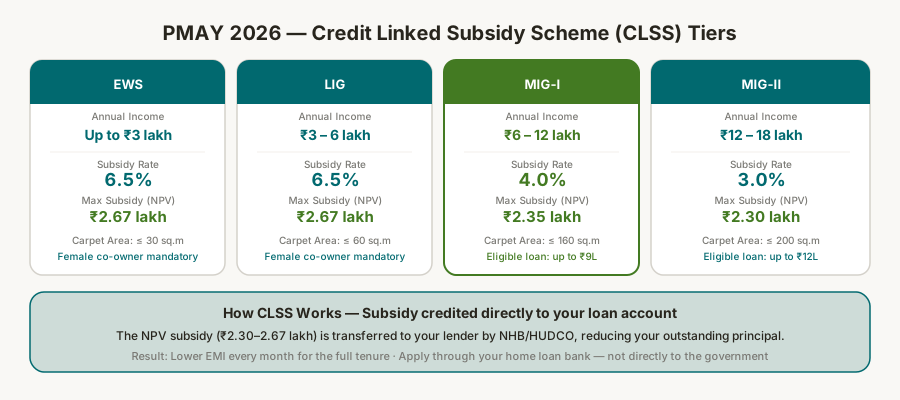
PMAY classifies beneficiaries into four income groups. Your annual household income (from all earning members combined) determines your category.
| Income Category | Annual Income | Loan Eligible for Subsidy | Subsidy Rate | Max Subsidy | Carpet Area Limit |
|---|---|---|---|---|---|
| EWS (Economically Weaker Section) | Up to ₹3 lakh | Up to ₹6 lakh | 6.5% | ₹2.67 lakh | Up to 30 sq.m |
| LIG (Low Income Group) | ₹3–6 lakh | Up to ₹6 lakh | 6.5% | ₹2.67 lakh | Up to 60 sq.m |
| MIG-I (Middle Income Group I) | ₹6–12 lakh | Up to ₹9 lakh | 4.0% | ₹2.35 lakh | Up to 160 sq.m |
| MIG-II (Middle Income Group II) | ₹12–18 lakh | Up to ₹12 lakh | 3.0% | ₹2.30 lakh | Up to 200 sq.m |
Important: The subsidy applies only to the eligible loan amount (₹6L / ₹9L / ₹12L). The balance of your loan — if you borrow more — is at normal market rates. A ₹50 lakh borrower in MIG-I still gets the subsidy on the first ₹9 lakh; the remaining ₹41 lakh is at the bank's standard rate.
How the subsidy is calculated (NPV method)
The subsidy figure listed above is the Net Present Value (NPV) of the interest saving discounted at 9%. It is not the nominal sum of reduced interest payments. This is the rupee amount the government transfers to your lender upfront. The calculation is:
Subsidy amount (NPV) = Loan amount × Subsidy rate × Discount factor
For EWS/LIG: ₹6,00,000 × 6.5% subsidy over 20 years, discounted at 9% = ₹2,67,280
NHB (National Housing Bank) and HUDCO process and disburse these NPV amounts to lenders within 30–45 days of a successful application.
Eligibility — The Full Checklist
Who qualifies
- Indian citizen — no age bar, but most lenders require the borrower to be 18–70 at loan maturity.
- First-time home ownership — no beneficiary family member (head, spouse, unmarried children) should own a pucca house anywhere in India. This is verified through Aadhaar linkage and land record queries.
- Urban area — property must be in a statutory town, notified planning area, development authority area, industrial development authority area, or special purpose area. Rural areas fall under PMAY-Gramin (a separate scheme with different rules).
- Income within the applicable band — self-declared but subject to verification. Misrepresentation is grounds for subsidy recovery.
- Property carpet area within limits — carpet area (not built-up or super built-up area) must be within the limits for your income category.
Who is excluded
- Anyone who previously received PMAY benefit under any vertical.
- Households that own a pucca house anywhere in India at the time of application.
- MIG applicants whose income exceeds ₹18 lakh.
- Properties with carpet area exceeding the category limit.
- Loans taken for property purchase outside India.
The woman co-owner requirement
For EWS and LIG categories, the property must be in the name of the female head of household or jointly with her. This is a hard eligibility condition — applications without a female co-owner (or female sole owner) in EWS/LIG are rejected. For MIG-I and MIG-II, female co-ownership is preferred but not mandatory.
PMAY 2.0 vs Original PMAY — Key Changes
| Feature | PMAY 1.0 (2015–2022) | PMAY 2.0 (2024–2029) |
|---|---|---|
| Launch | June 2015 | August 2024 |
| Outlay | ₹1.5 lakh crore | ₹2.30 lakh crore |
| Target beneficiaries | 1.18 crore homes | 1 crore homes (urban) |
| CLSS for MIG | Available (closed Mar 2021) | Being notified (check lender) |
| Digital verification | Partial | Aadhaar + DigiLocker integrated |
| New addition | — | PM Surya Ghar (solar subsidy) integration |
As of mid-2026: CLSS for EWS and LIG is active under PMAY 2.0. The MIG component is under notification — check with your lender whether the MIG CLSS disbursement has resumed at the time of your application.
How to Apply for PMAY — Step by Step
Step 1: Check eligibility online
Visit the PMAY-Urban portal (pmaymis.gov.in) and use the "Search Beneficiary" tool to check whether your Aadhaar has already been registered for any PMAY benefit.
Step 2: Apply through your home loan lender
You do not apply directly to the government. You apply through your home loan bank or Housing Finance Company (HFC). All PLIs (Primary Lending Institutions) empanelled with NHB/HUDCO are authorised to process CLSS applications. This includes SBI, HDFC Bank, ICICI Bank, Bank of Baroda, LIC Housing Finance, PNB Housing, and ~200 others.
At the time of loan sanction, inform your relationship manager that you want to apply under PMAY-CLSS. The bank will give you a CLSS application form (Form 1 or Form 2 depending on income category).
Step 3: Submit documents
| Document | Purpose |
|---|---|
| Aadhaar card (all applicants) | Identity + first-time ownership verification |
| PAN card | Income verification |
| Income proof (salary slips / ITR 2 years) | Income category determination |
| Property documents (sale agreement / allotment letter) | Carpet area and property location verification |
| Affidavit — no pucca house ownership | Self-declaration of first-time buyer status |
| Caste certificate (for EWS SC/ST/OBC) | Category verification (if applicable) |
| Marriage certificate (if joint applicant) | Relationship proof |
Step 4: Lender submits to NHB/HUDCO
After your loan is disbursed, your lender compiles your CLSS application and submits it to NHB (for MIG) or HUDCO (for EWS/LIG). Processing typically takes 30–60 days.
Step 5: Subsidy credited to your loan account
Once approved, the subsidy amount (NPV) is credited directly to your outstanding loan account. Your loan statement will show a credit entry labelled "CLSS subsidy." Your new EMI — recalculated on the reduced principal — takes effect from the next billing cycle.
Subsidy Calculation — Worked Examples
Example A: LIG borrower, ₹25 lakh loan
- Income: ₹5.2 lakh/year (LIG)
- Loan amount: ₹25 lakh
- Loan tenure: 20 years
- Rate: 8.75%
- Normal EMI: ₹22,063
- Subsidy eligible loan: ₹6 lakh (subsidy = ₹2,67,280)
- Post-subsidy outstanding: ₹25,00,000 − ₹2,67,280 = ₹22,32,720
- Revised EMI: ₹19,702
- Monthly saving: ₹2,361 | Total saving over 20 years: ₹5.67 lakh
Example B: MIG-I borrower, ₹40 lakh loan
- Income: ₹9.5 lakh/year (MIG-I)
- Loan amount: ₹40 lakh
- Loan tenure: 20 years
- Rate: 8.90%
- Normal EMI: ₹35,767
- Subsidy eligible loan: ₹9 lakh (subsidy = ₹2,35,068)
- Post-subsidy outstanding: ₹40,00,000 − ₹2,35,068 = ₹37,64,932
- Revised EMI: ₹33,662
- Monthly saving: ₹2,105 | Total saving over 20 years: ₹5.05 lakh
Example C: MIG-II borrower, ₹55 lakh loan
- Income: ₹15 lakh/year (MIG-II)
- Loan amount: ₹55 lakh
- Loan tenure: 20 years
- Rate: 9.00%
- Normal EMI: ₹49,479
- Subsidy eligible loan: ₹12 lakh (subsidy = ₹2,30,156)
- Post-subsidy outstanding: ₹55,00,000 − ₹2,30,156 = ₹52,69,844
- Revised EMI: ₹47,408
- Monthly saving: ₹2,071 | Total saving over 20 years: ₹4.97 lakh
Common Reasons PMAY Applications Are Rejected
- Property carpet area exceeds the limit — Buyers often confuse carpet area with super built-up area. A flat with a 65 sq.m carpet area is not LIG-eligible (limit is 60 sq.m), even if the super built-up is listed as 900 sq.ft.
- Aadhaar not seeded with the bank account — NHB verification requires Aadhaar to be linked to the bank account used for the home loan.
- Existing property in spouse's or parent's name — The "no pucca house" condition applies to the entire family unit (head of household + spouse + unmarried children). If a parent living in the same household owns a pucca house, EWS/LIG eligibility is affected.
- Applying after loan disbursement without pre-informing the lender — CLSS must be flagged at or before the point of first disbursement. Post-disbursement applications to the subsidy scheme are rejected at the NHB/HUDCO stage.
- Income misclassification — Declaring household income for one member when both spouses earn (combined ₹7+ lakh), placing the family in LIG when they are actually MIG.
PMAY and Home Loan Tax Benefits — Can You Claim Both?
Yes. PMAY subsidy and income tax benefits (Section 24b, 80C, 80EEA) are separate and can be claimed simultaneously. The PMAY subsidy reduces your principal; you still claim full interest deduction under Section 24(b) on the actual interest you pay, and principal repayment under 80C. The only nuance: Section 80EEA requires the stamp duty value to be ≤ ₹45 lakh — some properties that qualify for PMAY MIG-II (larger homes) may not qualify for 80EEA.
Frequently Asked Questions
Is PMAY available for resale / secondary market properties?
Yes, for CLSS. PMAY subsidy is available for purchase of a new home from a developer AND for purchase of an existing resale property, as long as all eligibility conditions (first-time buyer, carpet area, income) are met.
Can I apply for PMAY if I already have a home loan?
You cannot apply retroactively on a loan that has already been fully disbursed and closed. You can apply on an active loan if it was sanctioned after the PMAY 2.0 notification date and you did not previously receive PMAY benefits. Check with your lender on their specific cutoff.
How long does the subsidy take to arrive?
Typically 30–75 days from lender submission to NHB/HUDCO. Banks are required to submit claims within 30 days of first disbursement. If your loan was disbursed 3 months ago and you haven't seen a subsidy credit, contact your lender's CLSS nodal officer.
What happens if my income increases after I receive the subsidy?
The subsidy is not clawed back if your income increases after disbursement. It is assessed at the time of application. However, deliberately misrepresenting income at the time of application can result in recovery of the subsidy with interest and penalties.
Does PMAY apply to loans for land purchase?
No. CLSS applies only to home loans for construction of a new dwelling unit or purchase of an existing/new dwelling unit. Pure land purchase without construction is not eligible.
Can NRIs apply for PMAY?
Non-Resident Indians (NRIs) are not eligible for PMAY CLSS. The scheme is for Indian resident citizens. The property must also be in India, and the applicant must currently reside in an urban area or be purchasing in an urban area.
Try the calculator
Run your own numbers in seconds. Pick the calculator that fits your loan type.