Two-Wheeler Loan India 2026 — Interest Rates, EMI Calculator & How to Get the Best Deal
Key Takeaways
- PSU banks (SBI, Bank of Baroda) offer two-wheeler loans from 7.9–9.5%. Dealer DSA arrangements with NBFCs typically run 14–22%.
- A ₹1 lakh bike purchased via dealer financing at 18% costs ₹1,29,700 over 3 years vs ₹1,13,500 via a bank at 9% — a ₹16,200 difference.
- Processing fees, insurance bundling, and prepayment penalties are the three hidden cost drivers most borrowers ignore.
- Two-wheeler loans are predominantly on a flat-rate basis — meaning the stated "9%" is actually ~16.5% effective rate. Always ask for the APR or reducing balance rate.
- A CIBIL score above 720 and a salary account with the target lender are the two fastest ways to unlock the lowest available rate.
India is the world's largest two-wheeler market, with over 17 million units sold annually. For most buyers, a bike or scooter is the primary commute vehicle, and a loan is the primary way to fund it. Yet two-wheeler loan pricing is one of the least transparent spaces in retail lending — with stated rates, effective rates, and dealer scheme rates all pointing to different numbers.
This guide cuts through the confusion: real rate comparisons, EMI calculations, eligibility rules, and the dealer financing traps to avoid in 2026.
Two-Wheeler Loan Interest Rates in 2026 — Lender Comparison
| Lender | Interest Rate | Loan Amount | Tenure | Processing Fee |
|---|---|---|---|---|
| SBI Two-Wheeler Loan | 7.9% – 9.2% p.a. (reducing) | Up to ₹3 lakh (up to 85% on-road) | Up to 4 years | 1% + GST |
| Bank of Baroda | 8.5% – 10.5% p.a. | Up to ₹3 lakh | Up to 5 years | ₹250–₹1,000 |
| HDFC Bank | 10.5% – 14.5% p.a. | Up to ₹2.5 lakh | Up to 4 years | 2–2.5% |
| Bajaj Finserv | 9.9% – 18.0% p.a. | Up to ₹2 lakh | Up to 5 years | Up to 3.5% |
| Hero FinCorp | 12.0% – 20.0% p.a. | Up to ₹1.5 lakh | Up to 4 years | 2–3.5% |
| IDFC FIRST Bank | 10.0% – 15.0% p.a. | Up to ₹2.5 lakh | Up to 4 years | 2% |
| Dealer Floor Finance (NBFCs) | 14.0% – 24.0% p.a. | On-road price | Up to 3 years | Often bundled |
Important: The rates in the table are reducing balance rates (the fair comparison basis). Many lenders — especially Hero FinCorp and dealer DSAs — quote flat rates, which appear lower but correspond to nearly double the reducing-balance equivalent. Always clarify which method is being used.
Flat Rate vs Reducing Balance: The Two-Wheeler Trap
Two-wheeler dealers and their financing partners frequently quote rates like "1.5% per month flat" or "12% flat per annum." These sound reasonable until you do the conversion:
Flat rate to reducing balance conversion (approximate):
| Flat Rate | Equivalent Reducing Balance Rate | Difference |
|---|---|---|
| 8% flat | ~14.5% | +6.5% |
| 10% flat | ~18.1% | +8.1% |
| 12% flat | ~21.5% | +9.5% |
| 14% flat | ~24.9% | +10.9% |
Rule of thumb: Multiply the flat rate by ~1.8 to get the approximate reducing balance equivalent.
If a dealer finance executive tells you the rate is "just 10% flat," the real EMI interest you're paying is equivalent to ~18% on a reducing balance basis. The formula is: Effective Rate ≈ Flat Rate × 2 × (n+1) / (n × (n+1)/6 + 1) where n is number of instalments.
EMI Comparison — Bank vs Dealer Finance
For a ₹1 lakh two-wheeler loan (typical entry-level motorcycle or scooter):
3-year (36-month) tenure
| Lender Type | Rate | Monthly EMI | Total Interest | Total Paid |
|---|---|---|---|---|
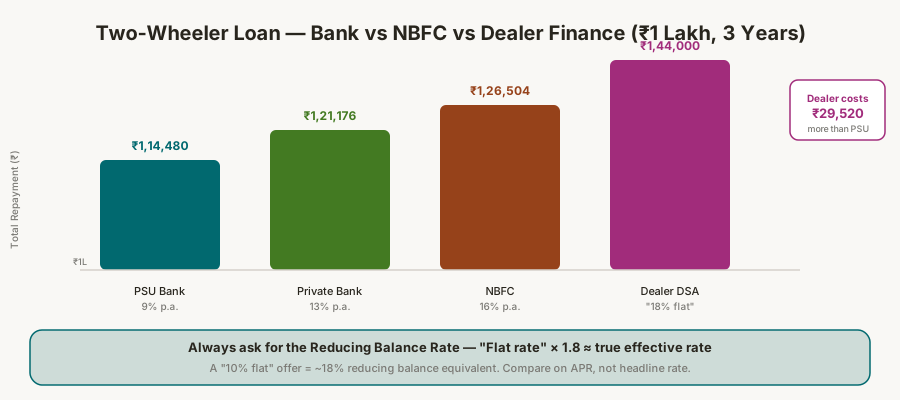
| PSU Bank (SBI) | 9% p.a. reducing | ₹3,180 | ₹14,480 | ₹1,14,480 |
| Private Bank (HDFC) | 13% p.a. reducing | ₹3,366 | ₹21,176 | ₹1,21,176 |
| NBFC (Bajaj) | 16% p.a. reducing | ₹3,514 | ₹26,504 | ₹1,26,504 |
| Dealer DSA (18% flat → ~32% reducing) | "18% flat" | ₹4,000 | ₹44,000 | ₹1,44,000 |
The difference between a PSU bank and dealer financing on a ₹1 lakh loan is ₹29,520 in total repayment — nearly 30% of the bike's cost. On a ₹1.5 lakh loan, this gap widens to ~₹44,000.
Eligibility for a Two-Wheeler Loan in India
Salaried applicants
- Minimum age: 18 years (21 for some lenders)
- Minimum income: ₹10,000–₹15,000 net monthly salary
- Employment: Minimum 6 months in current job (1 year for PSU banks)
- CIBIL score: 680+ (720+ for best rates at PSU banks)
Self-employed applicants
- Minimum 2 years of business continuity (ITR-based income proof)
- Bank statement showing regular income (12 months preferred)
- Business registration documents
Students
Most lenders do not offer two-wheeler loans to students without a co-applicant (earning parent or guardian). NBFCs like Bajaj Finserv and Hero FinCorp have student loan products with relaxed criteria — but at higher rates (18–24% flat).
Down Payment — How Much Do You Actually Need?
Two-wheeler loans typically finance 80–90% of the on-road price. The on-road price includes:
- Ex-showroom price
- Registration charges (varies by state)
- Insurance (1-year own damage + 5-year third party)
- Accessories (if bundled)
- Dealer handling charges
For a ₹90,000 ex-showroom motorcycle with ₹8,000 registration and ₹12,000 insurance, the on-road price is approximately ₹1,10,000. A bank financing 85% means your down payment is ₹16,500.
Dealer trick to watch for: Dealers sometimes inflate the on-road price in the loan application (adding "extended warranty," "accessories bundle," or "handling charges") to maximise the loan amount and their DSA commission. Always verify the loan disbursement amount against the actual invoice.
Two-Wheeler Loan — Hidden Costs to Watch
1. Insurance bundling
Lenders (especially NBFCs) frequently bundle comprehensive insurance into the loan amount. This increases your loan principal, on which you pay interest for the entire tenure. Buying insurance separately is almost always cheaper. The gap can be ₹3,000–₹8,000 in present value terms on a ₹1 lakh loan.
2. Processing fees
Processing fees of 2–3.5% add ₹2,000–₹3,500 to a ₹1 lakh loan upfront. PSU banks typically charge ₹250–₹500. This fee is non-refundable even if you cancel the loan before the first EMI.
3. Prepayment penalties
Many two-wheeler loan contracts — especially with NBFCs — include 2–5% prepayment penalty if you pay off early. On a ₹1.5 lakh loan repaid in month 18 (out of 36), a 4% penalty costs ₹3,200. PSU banks typically allow free prepayment after 6–12 months.
4. Bounce charges
One missed EMI payment typically incurs ₹500–₹1,500 bounce charge plus a penal interest at 2–3% per month on the overdue amount. On a ₹3,000 EMI, a single bounce and delay of 30 days can cost ₹800–₹1,200 in additional charges.
How to Get the Lowest Two-Wheeler Loan Rate
Step 1: Check your bank first. If you have a savings account or salary account with SBI, Bank of Baroda, or your primary bank, check their two-wheeler loan rate first. Banks offer preferential rates to existing account holders — often 50–100 bps lower than branch walk-in rates.
Step 2: Avoid the showroom's finance executive. The dealer's finance executive earns a commission (typically 1–2% of loan amount) on every loan they route to an NBFC. Their incentive is to place you with the highest-commission lender, not the cheapest rate lender.
Step 3: Apply online. SBI's two-wheeler loan can be applied for via their online portal and YONO app. Online applications often carry lower processing fees and are processed faster.
Step 4: Negotiate the processing fee. Processing fees are negotiable, especially if you have a good CIBIL score and an existing relationship with the bank. Ask for a fee waiver or reduction — many banks have authority to waive processing fees for customers with 750+ CIBIL.
Step 5: Opt for shorter tenure. A 2-year tenure vs 4-year tenure on a ₹1 lakh loan at 9% saves you ₹5,100 in total interest. If the EMI fits your budget, shorter is always cheaper.
Electric Two-Wheeler Loans — What's Different in 2026
Electric scooters and motorcycles have seen rapid adoption since 2023, and lenders have created specific products:
| Feature | Petrol Bike Loan | EV Two-Wheeler Loan |
|---|---|---|
| Typical LTV | 80–85% | 85–90% |
| Rate advantage | Standard | SBI offers 0.25% concession on EV loans |
| FAME-II subsidy (if applicable) | N/A | Reduces on-road price (dealer-applied) |
| Resale value concern | Established | Lenders cautious — may require larger down payment |
| Battery replacement loan | N/A | Some NBFCs offer battery top-up loans |
For EVs like the Ola S1 Pro, Ather 450X, or TVS iQube, the effective on-road price after FAME-II subsidy (where applicable) is lower than the ex-showroom price — which reduces the loan amount you need.
Frequently Asked Questions
Can I get a two-wheeler loan without income proof?
Formally, no — all lenders require income proof (salary slips, bank statement, or ITR). However, some NBFCs and dealer-linked financiers offer "minimal documentation" loans to salaried individuals with a recent salary account statement. These products typically carry higher rates (18–24%) to compensate for the underwriting risk.
Does two-wheeler loan affect CIBIL score?
Yes. A two-wheeler loan is a credit account that appears on your CIBIL report. Timely payments improve your score; missed EMIs hurt it. Opening a two-wheeler loan when you already have a home loan can temporarily lower your score by 5–15 points due to the credit enquiry and new account.
Can I transfer (balance transfer) my two-wheeler loan?
Yes, but it is uncommon in practice because two-wheeler loan balances are small and the processing fees for a new loan often negate the interest saving. It only makes financial sense if the rate differential is ≥ 3% and there's at least 18 months of tenure remaining.
What happens if I miss an EMI on my two-wheeler loan?
Missing one EMI triggers bounce charges (₹500–₹1,500) and penal interest. After 90 days of non-payment (3 missed EMIs), the account becomes NPA. For NBFCs with direct access to your vehicle RC, this can trigger repossession. The default also gets reported to CIBIL, lowering your score by 40–100 points.
Is it better to take a personal loan for a two-wheeler instead?
For amounts below ₹1.5 lakh, a two-wheeler loan is typically cheaper (8–14%) than a personal loan (12–18%). For amounts above ₹2 lakh — for premium motorcycles — a personal loan from your salary bank may be competitive. Compare the total cost (not just rate) including processing fees and prepayment terms.
Try the calculator
Run your own numbers in seconds. Pick the calculator that fits your loan type.