NRI Home Loan India 2026 — Complete Guide to Rates, Eligibility, and Repatriation Rules
Key Takeaways
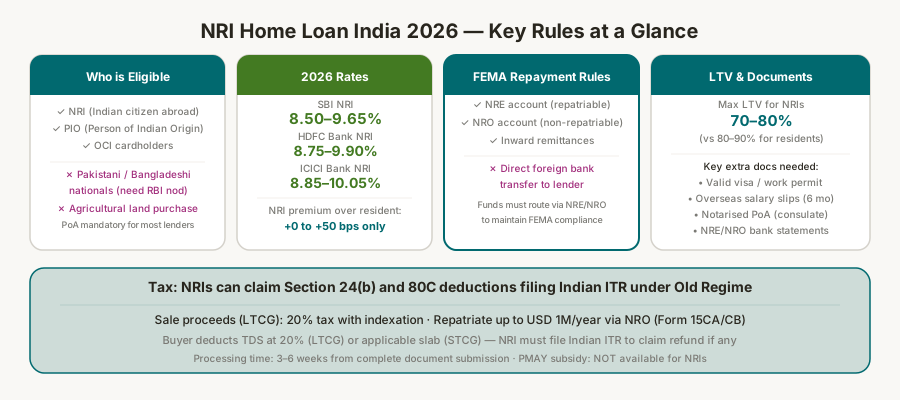
- NRIs can take home loans in India from most major banks and HFCs — at the same or slightly higher rates than resident Indians (typically 0–50 bps premium).
- EMI repayment must come from NRE (tax-free repatriation) or NRO accounts, or via inward remittances — not from any foreign bank account directly.
- Maximum loan-to-value (LTV) for NRIs is typically 75–80% vs 80–85% for residents; some lenders cap at ₹5–10 crore.
- A Power of Attorney (PoA) resident in India is mandatory for most NRI home loans — for signing documents, attending registration, and liaising with the lender on your behalf.
- Under FEMA, an NRI can purchase any number of residential and commercial properties in India — no RBI approval needed for purchase or loan repayment.
India's 32 million-strong NRI population represents one of the largest overseas real estate investment bases in the world. Whether driven by emotional ties, asset diversification, retirement planning, or rental income, NRI home purchases — and NRI home loans — follow a distinct set of rules shaped by FEMA (Foreign Exchange Management Act), RBI guidelines, and lender-specific credit policies.
This guide covers everything an NRI needs to know about taking a home loan in India in 2026: eligibility, rates, documentation, repayment mechanics, tax implications, and what happens to the proceeds when you eventually sell.
Who Is Eligible for an NRI Home Loan?
Definition of NRI for home loan purposes
Under FEMA and RBI guidelines, "NRI" for property purchase purposes includes:
- Non-Resident Indian (NRI): Indian citizen residing outside India for employment, business, or other purposes indicating indefinite stay abroad.
- Person of Indian Origin (PIO): Foreign national (not Pakistani or Bangladeshi) who held an Indian passport at any time, or whose parent/grandparent was an Indian citizen.
- Overseas Citizen of India (OCI): Registered OCI cardholders are treated at par with NRIs for property purchase and home loan purposes.
Pakistani and Bangladeshi nationals of Indian origin require specific RBI approval for property purchase and are generally not eligible for standard NRI home loans.
Who CANNOT take an NRI home loan in India
- Foreign nationals (no Indian origin) — even if employed in India on a work visa
- NRIs purchasing agricultural land, plantation property, or farmhouses (these require RBI approval)
- NRIs purchasing property outside India (obviously not an Indian home loan)
NRI Home Loan Rates — 2026 Comparison
Most banks price NRI home loans at the same floating rate benchmarks (RLLR/EBLR linked) as resident loans, with an NRI premium of 0–50 bps depending on the lender and the borrower's profile.
| Lender | NRI Home Loan Rate (2026) | Resident Rate (Reference) | NRI Premium | Max Loan |
|---|---|---|---|---|
| SBI NRI Home Loan | 8.50% – 9.65% | 8.40% – 9.55% | +0.10% | ₹15 crore |
| HDFC Bank NRI | 8.75% – 9.90% | 8.70% – 9.80% | +0.05–0.10% | ₹10 crore |
| ICICI Bank NRI | 8.85% – 10.05% | 8.75% – 9.90% | +0.10% | ₹10 crore |
| Bank of Baroda NRI | 8.50% – 9.75% | 8.40% – 9.65% | +0.10% | ₹10 crore |
| LIC Housing Finance NRI | 8.65% – 9.80% | 8.50% – 9.70% | +0.15% | ₹5 crore |
| Axis Bank NRI | 8.75% – 9.95% | 8.70% – 9.90% | +0.05% | ₹5 crore |
Rates are floating, RLLR/EBLR-linked. The spread above benchmark varies by NRI category, employment (salaried vs self-employed abroad), country of residence, and loan amount. NRIs in the Gulf (UAE, Saudi, Kuwait) and the US typically get the best rates; NRIs in Africa or certain Southeast Asian countries may face stricter underwriting.
NRI Home Loan Eligibility Criteria
Income eligibility
| Applicant Type | Minimum Income | Additional Requirements |
|---|---|---|
| Salaried NRI (Gulf/US/UK/Singapore/Australia) | USD 1,500–2,500/month net | 2 years continuous employment |
| Salaried NRI (other countries) | USD 2,500/month net | 3 years employment, some lenders require 5 |
| Self-employed NRI | Varies by lender | ITR/equivalent foreign tax return; 3–5 year business history |
| Merchant Navy | Special NRI status; typically USD 2,000/month | Continuity of contract |
CIBIL and credit score
NRIs who have an existing CIBIL history (prior home loan, personal loan, or credit card in India) are evaluated on their CIBIL score — same thresholds as residents (720+ for best rates, 700–720 for standard, below 700 increasingly difficult). NRIs with no India credit history are evaluated on their overseas credit report (FICO, Experian UK, etc.) and employment profile.
Loan-to-Value (LTV)
| Property Value | Resident LTV | NRI LTV |
|---|---|---|
| Up to ₹30 lakh | Up to 90% | Up to 80–85% |
| ₹30–75 lakh | Up to 80% | Up to 75–80% |
| Above ₹75 lakh | Up to 75% | Up to 70–75% |
NRIs typically need a larger down payment — 20–30% of property value depending on the lender.
Documents Required for an NRI Home Loan
Identity and residential status
- Valid Indian passport (all pages)
- Visa / residence permit / work permit of country of residence
- OCI card (if applicable)
- Aadhaar card (India address)
Income documents — Salaried NRI
- Latest 3–6 months salary slips (or payroll statements)
- Last 2 years employment contract or appointment letter
- Last 6 months bank statement (foreign bank account showing salary credits)
- Last 2 years NRE/NRO account statements in India
- Last 2 years overseas Income Tax Returns (or equivalent — W2 for US NRIs, P60 for UK NRIs)
Income documents — Self-Employed NRI
- Last 3 years Profit & Loss statements (audited where possible)
- Last 3 years tax returns (Indian ITR and/or foreign equivalent)
- Business registration and continuity proof
- Last 12 months bank statements (business + personal)
Property documents (same as resident home loans)
- Sale agreement / allotment letter
- Title chain documents (7/12 extract or EC)
- Approved building plan
- NOC from builder/society
Power of Attorney
A Power of Attorney (PoA) document in favour of a resident Indian is mandatory for virtually all NRI home loans. The PoA holder:
- Signs loan documents at the bank on your behalf (if you cannot be present in India)
- Attends property registration at the Sub-Registrar's office
- Receives and routes EMI payments
- Handles any post-disbursement correspondence
The PoA must be notarised at the Indian consulate/embassy in your country of residence, and then adjudicated/registered in India (at a local Sub-Registrar office).
Repayment Rules — NRE vs NRO Account
This is the most misunderstood aspect of NRI home loans. Under FEMA:
- EMI must be paid from Indian accounts (NRE or NRO), not from foreign bank accounts directly.
- NRE account funds are fully repatriable — you can move money back abroad. Repaying home loan EMI from NRE means the funds originated abroad and can be traced back.
- NRO account funds are non-repatriable (with exceptions up to USD 1 million per year). Rental income from India typically accumulates in NRO; this can be used for EMI repayment.
- Inward remittances (wire transfers from abroad to your NRE/NRO account) are an acceptable source and create the cleanest FEMA audit trail.
What you cannot do: Transfer money from your UK/US/UAE current account directly to the lender's EMI collection account. It must go via your NRE/NRO account.
| Repayment Source | Permitted? | Repatriable? |
|---|---|---|
| NRE account | Yes | Yes (principal + interest repaid via NRE can be repatriated) |
| NRO account | Yes | No (except within USD 1M/year limit) |
| Inward remittance → NRE → EMI | Yes | Yes |
| Rental income in India (via NRO) | Yes | Subject to NRO repatriation rules |
| Foreign bank account directly | No | N/A |
Tax Implications for NRI Home Loans
In India
- Section 24(b): NRIs can claim the home loan interest deduction (up to ₹2 lakh/year for self-occupied property) under the Old Tax Regime — same as residents.
- Section 80C: Principal repayment qualifies for 80C deduction (up to ₹1.5 lakh/year, combined 80C limit) — available to NRIs filing Indian ITR.
- Rental income: If the property is let out, rental income is taxable in India. TDS at 30% is deducted by the tenant.
- Capital gains on sale: Short-term capital gains (property held < 2 years) taxed at applicable income slab. Long-term capital gains (≥ 2 years) taxed at 20% with indexation benefit. TDS at 20% (LTCG) or applicable slab (STCG) is deducted by the buyer at source.
In your country of residence
Most countries with tax treaties with India (US, UK, UAE, Australia, Canada, Singapore) allow a foreign tax credit for income/capital gains taxes paid in India, avoiding double taxation. Consult a tax advisor in your country of residence; the specifics vary by treaty.
UAE note: UAE has no personal income tax, so NRIs there are only subject to Indian tax rules.
Repatriation of Sale Proceeds
When you eventually sell the property:
- Repatriation limit: Up to USD 1 million per financial year per NRI (from NRO account) for property sale proceeds, without RBI approval.
- If purchased via home loan from NRE funds: The principal amount you remitted (down payment + EMIs from NRE) is repatriable. Appreciation is treated as capital gains.
- Process: Sale proceeds are typically deposited in NRO account (after TDS deduction by buyer). Transfer to NRE requires filing Form 15CB (CA certificate) and Form 15CA.
- For loans repaid via NRE account: Proceeds equivalent to the NRE repayments are repatriable with CA certification — maintain a clear paper trail of each NRE-to-EMI transfer.
Top NRI Home Loan Banks — How to Choose
SBI NRI Home Loan (NRI Home Loan Scheme): Best rates, government bank reliability, extensive NRI desk at branches. Process through SBI's NRI branches or NRI banking centres. Takes 3–5 weeks.
HDFC Bank / HDFC Ltd: Strong NRI underwriting track record, tie-ups with NRI community associations in the Gulf. Accepts more documentation formats (e.g., UAE Labour Ministry salary certificate).
ICICI Bank NRI: Best digital process — full loan application, document upload, and status tracking online. Preferred by NRIs in the US, UK, and Singapore.
LIC Housing Finance: Best for larger loan amounts (₹3–10 crore) and NRIs with self-employment income or irregular earnings patterns.
Frequently Asked Questions
Can an NRI take a joint home loan in India with a resident Indian?
Yes. Joint NRI-resident applications are common (e.g., NRI husband + resident mother or spouse). The resident co-applicant strengthens the application and simplifies document submission. Both co-applicants can independently claim tax benefits if both are co-owners on the property.
Is a PoA mandatory if I can visit India?
If you are physically present in India to sign all loan documents and attend property registration, a PoA is technically not required. However, most lenders recommend one to handle any post-disbursement issues during your absence. A restricted PoA limited to specific acts (loan documentation + registration) is safer than a general PoA.
Can NRIs avail PMAY subsidy?
No. PMAY-CLSS is available only to resident Indian citizens. NRIs purchasing property in India are not eligible for PMAY benefits.
What happens if I become a resident Indian during the loan tenure?
Your loan continues as-is. You inform the bank of your status change. Repayment can now come from your resident savings account. There are no prepayment penalties or rate changes triggered solely by change of residency status.
Can I take an NRI home loan for a plot purchase?
Plot loans (land purchase without immediate construction) are generally not offered under NRI home loan schemes. Some lenders offer "NRI plot + construction" loans where construction must begin within 2–3 years. Pure plot purchases for investment must be funded via NRO remittances.
How long does it take to get an NRI home loan sanctioned?
Typical timeline: 3–6 weeks from complete document submission. The notarised/apostilled PoA processing (consulate → India adjudication) often adds 2–3 weeks. Banks with dedicated NRI desks (SBI, ICICI, HDFC) process faster than general branches.
Try the calculator
Run your own numbers in seconds. Pick the calculator that fits your loan type.