Debt Consolidation Loan India 2026 — How to Merge Multiple Loans and Cut Your Monthly Outflow
Key Takeaways
- Debt consolidation makes financial sense only when the blended interest rate of your current loans is higher than the consolidated loan rate. Run the numbers before applying.
- A personal loan at 13–15% is the most accessible consolidation vehicle; a Loan Against Property (LAP) at 9–10% is cheapest but requires collateral and longer processing.
- Consolidating high-rate debt (credit card at 36–42%, personal loan at 18%+) into a 13% personal loan reduces your interest burden by 25–65% on those amounts.
- The psychological benefit — one EMI, one due date, one lender — is real, but do not pay a higher rate for it.
- If you consolidate and then run up new credit card debt, you have made your situation worse. Consolidation is a tool, not a cure.
By the time most borrowers consider debt consolidation, they're managing 3–5 EMI debit dates, tracking interest on different balances, and watching their CIBIL score wobble as one or two payments slip. The promise of debt consolidation — one EMI, one lender, lower outflow — is genuine. But executed poorly, it can increase your total interest cost, extend your repayment timeline by years, and leave you worse off.
This guide provides an honest framework for when debt consolidation works in India, which product to use, how to calculate whether it saves you money, and the execution steps for 2026.
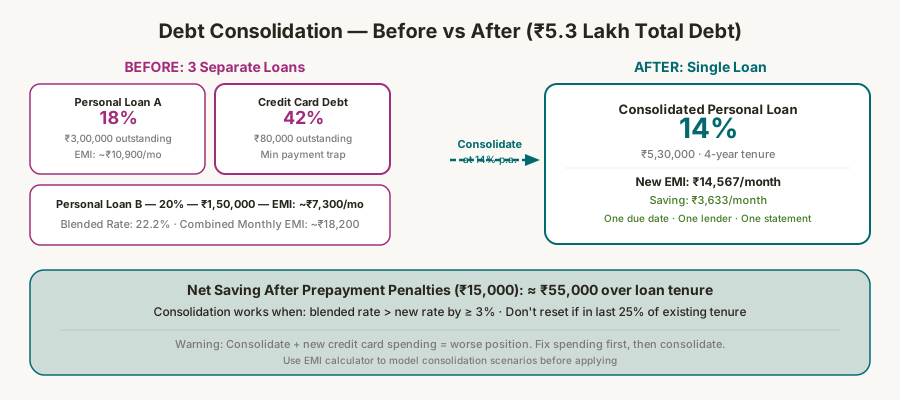
What Is Debt Consolidation?
Debt consolidation is the process of taking a new loan (or credit facility) at a lower or more manageable interest rate to pay off two or more existing loans. After consolidation, you owe money to a single lender, pay a single EMI, and ideally pay less total interest.
When consolidation makes sense
- Your existing loans carry materially higher rates than what you can consolidate into
- You are juggling multiple payment dates and occasionally miss payments (triggering bounce charges and CIBIL damage)
- Your total EMI outflow exceeds 50% of your monthly income and you're cash-flow stressed
- You are servicing credit card revolving debt at 36–42% and can access a personal loan at 13–15%
When consolidation does NOT make sense
- You have a home loan at 8.5% and a car loan at 9.5% — both already cheap; consolidating into a 13% personal loan is worse
- Your existing loans have large prepayment penalties that wipe out the rate benefit
- You're in the last 25% of tenure on your existing loans (the interest portion is small; you'd reset the amortisation clock)
- Your CIBIL score has already dropped below 700, making it hard to get a good consolidation rate
The Consolidation Math — Step by Step
Step 1: Calculate your blended rate
Blended rate = Sum of (each loan balance × its rate) ÷ Total outstanding balance
Example:
| Loan | Outstanding | Rate |
|---|---|---|
| Personal loan A | ₹3,00,000 | 18% |
| Credit card debt | ₹80,000 | 42% |
| Personal loan B | ₹1,50,000 | 20% |
| Total | ₹5,30,000 | — |
Blended rate = (3,00,000 × 18% + 80,000 × 42% + 1,50,000 × 20%) ÷ 5,30,000 = (54,000 + 33,600 + 30,000) ÷ 5,30,000 = 1,17,600 ÷ 5,30,000 = 22.2%
Any consolidation loan below 22.2% will reduce your interest burden.
Step 2: Calculate current total monthly outflow
Add up all existing EMIs. In the example above, approximate combined EMIs might be ₹18,000/month (3-year tenures at various stages).
Step 3: Model the consolidation loan
A ₹5.3 lakh personal loan at 14% for 4 years:
- Monthly EMI: ₹14,567
- Total interest: ₹1,69,224
- Total repaid: ₹6,99,224
Current trajectory (completing existing loans on schedule):
- Estimated remaining interest: ₹2,40,000+
Monthly saving: ~₹3,433 | Interest saving over remaining term: ~₹70,000+
Step 4: Factor in prepayment costs
If existing lenders charge prepayment penalties:
- 4% on ₹3 lakh personal loan A = ₹12,000
- 2% on ₹1.5 lakh personal loan B = ₹3,000
- Credit card closure: usually free
Deduct ₹15,000 from your projected savings. Net saving: ~₹55,000.
Consolidation Products — Which One to Use
Option 1: Personal Loan for Debt Consolidation
Rate: 11–18% p.a. (depending on CIBIL, income, lender) Loan amount: Up to ₹40 lakh (some lenders go higher) Tenure: 1–5 years Collateral: None required
Best for: Consolidating unsecured debt (credit cards, personal loans) when total balance is under ₹15–20 lakh.
Lender tips: HDFC Bank, Axis Bank, and ICICI Bank offer "debt consolidation" as a specific loan purpose — some have preferential rates and faster processing for this use case. Kotak Mahindra Bank and Yes Bank are competitive for applicants with 750+ CIBIL.
Option 2: Loan Against Property (LAP) for Debt Consolidation
Rate: 9–11.5% p.a. Loan amount: 50–70% of property market value Tenure: Up to 15 years Collateral: Residential or commercial property
Best for: Consolidating large balances (₹20 lakh+) when you own property and can sustain a 45–60-day processing timeline.
Trade-off: You are converting unsecured debt into secured debt. Defaulting on a LAP means losing your property — a risk you did not carry on your personal loans. Use LAP consolidation only if you are confident in your repayment ability.
Option 3: Top-Up on Existing Home Loan
Rate: Home loan rate + 0.25–0.75% (typically 9–10% p.a.) Loan amount: Up to the original home loan sanction limit minus outstanding Tenure: Co-terminus with or shorter than remaining home loan tenure
Best for: Home loan borrowers with significant equity who want to consolidate a small number of high-rate loans (under ₹10–15 lakh) at near-home-loan rates.
How it works: If your original home loan was ₹50 lakh and you have repaid ₹15 lakh (outstanding ₹35 lakh), your lender may offer a ₹5–10 lakh top-up at 9.25%, which you use to pay off your personal loans at 18%.
Option 4: Balance Transfer to 0% Credit Card (Short-term)
Rate: 0% for 6–18 months (promotional) Available from: Select cards (Amex, certain HDFC/ICICI offers) Applicable to: Existing credit card balances only
Best for: Highly disciplined borrowers who can pay off a credit card balance within the 0% promotional window. If you carry a balance past the promotional period, the rate typically reverts to 36–42% — worse than before. This strategy requires strict discipline; it is not for everyone.
Consolidation Rate by CIBIL Score
Your CIBIL score is the single biggest determinant of the personal loan rate you'll get for consolidation:
| CIBIL Score | Typical Personal Loan Rate | Effective Saving vs 22% Blended |
|---|---|---|
| 750+ | 11.0–13.0% | 9–11 percentage points |
| 720–749 | 13.5–16.0% | 6–8.5 percentage points |
| 700–719 | 16.0–19.0% | 3–6 percentage points |
| Below 700 | 19.0%+ or rejected | Minimal or counterproductive |
If your CIBIL score has already been damaged by missed EMIs on your existing loans, consolidation may not unlock a materially better rate. In that case, focus first on repairing your score (12–18 months of on-time payments, reducing credit utilisation) before pursuing consolidation.
Step-by-Step: Executing a Debt Consolidation in India
1. Pull your CIBIL report. Download your free annual CIBIL report from cibil.com. Check for errors — disputes can take 30–45 days to resolve, so identify them early.
2. List all loans. Make a table: lender, outstanding balance, current rate, remaining tenure, prepayment penalty, and approximate remaining interest.
3. Calculate your blended rate (as shown above). Only proceed if a consolidation loan is available at least 3% below your blended rate.
4. Get soft quotes. Apply for a "soft inquiry" personal loan quote from 2–3 lenders. Soft inquiries do not affect your CIBIL score. Full hard inquiries (formal applications) do — avoid applying to 5 lenders simultaneously.
5. Calculate net saving. Factor in processing fees, prepayment penalties on existing loans, and the extended tenure (if any). If the net present value of savings is positive, proceed.
6. Get the consolidation loan disbursed. Have the funds transferred to your account.
7. Close existing loans in order. Pay off the highest-rate debt first (typically credit cards). Get written "no-dues certificates" from each closed lender. This is important for CIBIL — loan closures take 30–45 days to reflect.
8. Set up auto-debit for the single new EMI. Never pay a consolidation loan manually — NACH auto-debit eliminates the risk of missed payments.
The Biggest Mistake: Consolidate and Accumulate
The consolidation trap: you pay off all your credit cards via consolidation — and then within 6 months, you have new credit card balances because you never changed the spending behaviour that created the debt in the first place. Now you have both the consolidation loan EMI and new credit card revolving debt.
Studies of debt consolidation behaviour show that a substantial minority of borrowers end up with more total debt 18 months after consolidation than before. Consolidation solves a symptom; it does not fix the root cause.
Before consolidating, answer: Why do you have these debts? If it's a one-time event (medical emergency, job loss, a purchase you needed), consolidation makes sense. If it's structural overspending relative to income, consolidation buys time but doesn't fix the problem.
Frequently Asked Questions
Will debt consolidation hurt my CIBIL score?
Short-term: yes, slightly. A new loan application creates a hard inquiry (−5 to −15 points) and a new account temporarily lowers your average account age. Long-term: consolidation improves your score by reducing your credit utilisation ratio and ensuring consistent on-time payments. Most borrowers see a net score improvement within 9–12 months of successful consolidation.
Can I consolidate a home loan into a personal loan?
Technically possible but almost never advisable. Home loans carry rates of 8.5–9.5%; personal loans run 12–18%. You would be increasing your interest cost. If you want to consolidate other debts using your home equity, use a top-up loan or LAP instead.
Is there a minimum income to apply for a debt consolidation personal loan?
Most lenders require a net monthly income of ₹20,000–₹25,000. The total EMI (including the new consolidation EMI) should not exceed 50–60% of monthly net income (FOIR rule). If your existing EMIs are ₹25,000 on a ₹40,000 income, lenders may be reluctant to extend a large consolidation loan — your FOIR is already stressed.
How long does it take to complete a debt consolidation?
From application to final closure of all old loans: typically 3–6 weeks. Personal loan disbursement takes 2–7 business days for salaried applicants with salary accounts at the lender. Getting no-dues certificates from all old lenders adds another 7–21 days.
Can I consolidate a two-wheeler loan and a personal loan together?
Yes. Any combination of unsecured loans (personal, two-wheeler, consumer durable, credit card) can be consolidated into a single personal loan. Secured loans (home loans, car loans, LAP) generally cannot be consolidated via a personal loan because the personal loan balance typically falls short of those outstanding amounts.
Try the calculator
Run your own numbers in seconds. Pick the calculator that fits your loan type.